
Having a great product or service is no longer enough if potential customers cannot find your business online. Whether you run a local store, startup, professional service, or growing brand, your customers are already using search engines, social media, websites, and online reviews to decide where to spend their money.
A well-planned digital marketing strategy for small business can help you build visibility, reach the right audience, generate enquiries, and turn online attention into real business growth. The good news is that you do not need a massive marketing budget to get started. You need clear goals, the right channels, useful content, and consistent measurement.
Why Small Businesses Need a Digital Marketing Strategy
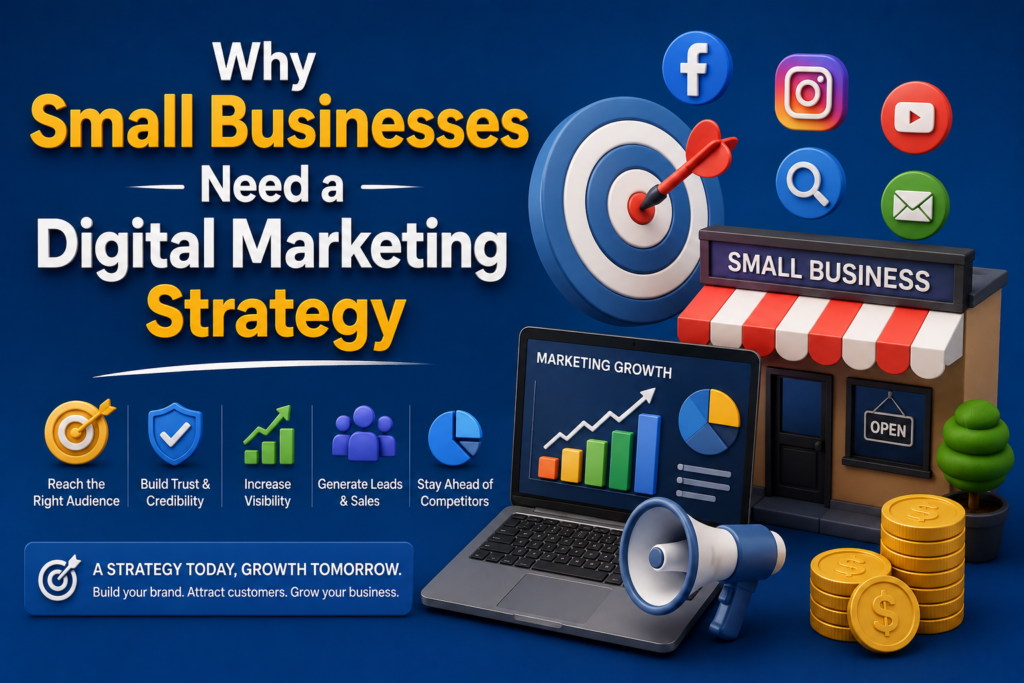
Many small businesses make the mistake of treating digital marketing as simply posting on Instagram or occasionally running an advertisement. These activities can be useful, but without a strategy, they may not produce consistent results.
A proper strategy connects your marketing activities to specific business objectives. It helps you:
- Reach potential customers who are actually interested in what you offer
- Build awareness and credibility
- Generate qualified enquiries
- Create stronger customer relationships
- Compete with larger businesses
- Understand which marketing activities are producing results
Instead of asking, “Where should I advertise?” start by asking, “Who are my customers, what problem do they have, and where do they look for solutions?”
How to Build a Digital Marketing Strategy for Small Business
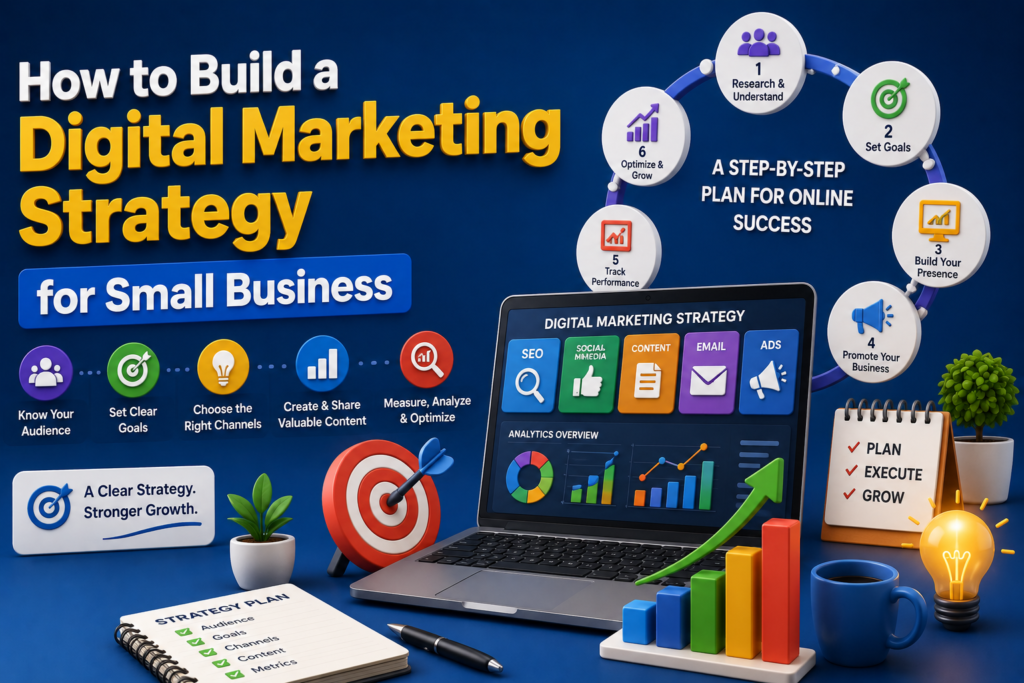
1. Define Your Target Audience
The foundation of any successful marketing strategy is knowing who you want to reach.
Identify your ideal customer’s location, age group, interests, needs, common problems, buying behavior, and the questions they search for online.
For example, a local clothing retailer and a B2B manufacturer may both use digital marketing, but their customers, content, platforms, and buying journeys can be completely different.
Avoid trying to target everyone. A clearly defined audience makes your messaging more relevant and your marketing budget more efficient.
2. Set Clear Marketing Goals
Your digital activities should support measurable business goals.
Instead of saying, “I want more online visibility,” create a specific objective such as:
- Increase qualified website enquiries
- Generate more leads
- Increase online sales
- Improve brand awareness
- Increase repeat purchases
- Grow relevant website traffic
SMART goals—specific, measurable, achievable, relevant, and time-bound—can make it easier to track progress and determine whether your strategy is working.
3. Build a Strong Online Presence
Your website is often one of the first places potential customers go to learn about your business.
Make sure visitors can quickly understand:
- What your business offers
- Who you help
- Why they should trust you
- How to contact you
- What they should do next
Your website should also work well on mobile devices, load efficiently, have clear navigation, and include useful trust signals such as customer reviews, testimonials, relevant information, and transparent contact details.
A strong online presence is not about looking impressive alone. It should make it easy for the right customer to take the next step.
4. Focus on Search and Helpful Content
Search engines can become an important source of long-term visibility for small businesses. Instead of creating content only to promote your products, answer the questions your potential customers are already asking.
Research relevant search terms and organize your content around customer intent.
For example, a business could create articles answering questions about pricing, comparisons, common problems, buying decisions, product usage, or industry trends.
Helpful content can attract people earlier in their buying journey and gradually establish your brand as a useful source of information.
Internal linking between related articles and important website pages can also help visitors discover more content while creating a clearer website structure.
5. Choose the Right Social Media Platforms
Being active on every social platform is not necessary.
The better approach is to identify where your target customers spend their time and focus your resources there.
Instagram can be useful for visually driven brands, Facebook can be valuable for communities and local audiences, LinkedIn can work well for professional and B2B audiences, while YouTube can support educational and video-led content.
Focus on creating content that informs, demonstrates expertise, answers questions, tells stories, and builds trust—not just promotional posts.
6. Use Paid Advertising Carefully
Paid advertising can help businesses reach targeted audiences faster, but spending money without a clear objective can quickly become expensive.
Start with a controlled budget and define what you want the campaign to achieve. Depending on your business, this could be website visits, enquiries, leads, purchases, or another measurable action.
Test different audiences, offers, headlines, and creative approaches. Most importantly, track what happens after someone clicks the advertisement.
The goal should not simply be to generate clicks. It should be to understand whether those clicks contribute to meaningful business results.
7. Build Relationships Through Email and Remarketing
Not every visitor will become a customer on their first interaction with your business.
Email marketing can help you maintain relationships with people who have already shown interest. Educational emails, useful updates, product information, and relevant offers can keep your business connected with potential and existing customers.
Remarketing can also help you reconnect with people who previously interacted with your website or content.
These activities are particularly useful because sustainable growth is not only about finding new customers—it is also about building relationships with existing ones.
8. Measure What Actually Matters
One of the biggest advantages of digital marketing is the ability to measure performance.
Instead of focusing only on likes or follower numbers, pay attention to metrics connected to business objectives, including:
- Website traffic
- Leads and enquiries
- Conversion rate
- Cost per lead
- Customer acquisition cost
- Engagement
- Sales
- Return on marketing investment
Regularly review your results. If a particular channel or piece of content performs well, understand why and consider investing more in what works.
Online Marketing Strategies for Small Business on a Limited Budget
Limited budgets do not mean that digital growth is impossible. They mean that prioritization becomes even more important.
Start with the fundamentals before trying to use every available marketing channel.
Some practical online marketing strategies for small business include improving your local online visibility, publishing helpful content, maintaining consistent social media activity, collecting genuine customer reviews, building an email database, and testing small paid campaigns.
You can also repurpose one useful piece of content across multiple platforms. A detailed blog article, for example, could become social media posts, a short video, an email, or an infographic.
The objective is to build a repeatable system rather than constantly chase the newest marketing trend.
Common Digital Marketing Mistakes Small Businesses Should Avoid
Even a good strategy can fail when execution is inconsistent. Watch out for these common mistakes:
- Trying to target everyone
- Posting without a clear objective
- Focusing only on follower counts
- Ignoring mobile users
- Copying competitors instead of understanding customers
- Failing to track conversions
- Changing strategies too quickly
- Expecting immediate results from organic marketing
- Making every piece of content promotional
Your strategy should evolve based on evidence, not impatience.
How to Create a Simple 90-Day Digital Marketing Plan
A simple 90-day approach can make digital marketing easier to manage.
Month 1 — Build the foundation
Define your audience, establish measurable goals, improve important website pages, set up analytics and tracking, and research relevant customer questions and topics.
Month 2 — Build visibility
Publish useful content, improve local visibility, maintain consistent social media activity, collect genuine reviews, and begin developing an email audience.
Month 3 — Measure and optimize
Review your performance data. Identify your strongest content and channels, improve pages that are generating opportunities, test paid campaigns if appropriate, and focus more resources on activities producing meaningful results.
If you want to explore additional digital marketing solutions and online growth ideas, you can learn more through MEXIMALOG.
Conclusion
Growing a business online does not require you to be everywhere at once. It requires a clear understanding of your customers, realistic goals, useful content, the right marketing channels, and consistent measurement.
A successful digital marketing strategy for small business should evolve as you learn what your customers respond to. Start with a strong foundation, focus your resources on the channels that matter most, measure the results, and continuously improve. Over time, small, consistent improvements can create a stronger online presence and a more predictable path toward growth.
Frequently Asked Questions
What is the best digital marketing strategy for a small business?
There is no single strategy that works for every business. Start by understanding your target audience, setting measurable goals, building a strong online presence, and selecting the channels where your customers are most active.
How can a small business market online with a low budget?
Focus on high-value fundamentals such as useful content, local visibility, customer reviews, organic social media, email marketing, and carefully controlled advertising. Prioritize channels based on your audience rather than trying everything.
How long does digital marketing take to produce results?
The timeframe varies by channel, competition, industry, budget, and execution. Some activities can generate results quickly, while organic content and search visibility often require consistent effort over a longer period.
Which digital marketing channels should a small business focus on first?
Start with the channels most closely connected to your customers’ behavior. For many businesses, this may include search, a professional website, social media, local visibility, email, or selected paid campaigns.
How can a small business measure digital marketing success?
Measure metrics connected to your business goals. Website traffic, qualified leads, conversion rate, customer acquisition cost, sales, and return on marketing investment are generally more useful than vanity metrics alone.